



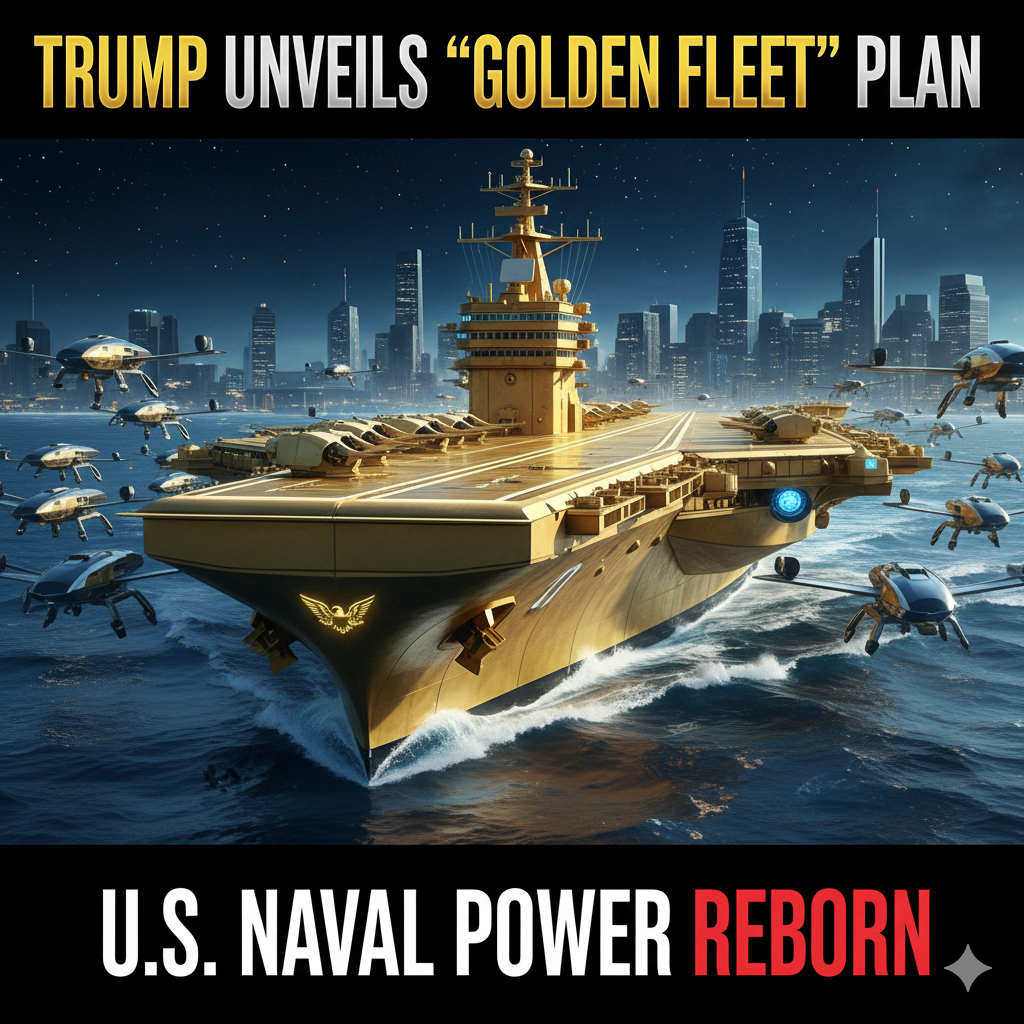

President Donald Trump’s “Golden Fleet” plan was unveiled in late 2025. It is a massive naval modernization initiative aimed at countering China’s maritime expansion and revitalizing the U.S. shipbuilding industry. The plan shifts U.S. naval strategy toward a “high-low” mix of super-sized, heavily armed “battleships” and a vast network of smaller, agile, and unmanned vessels.
Components of the “Golden Fleet”
- The New “Battleships”: The centerpiece is a new class of large surface combatants—dubbed “battleships”—expected to displace 20,000 to 30,000 tons. Unlike 20th-century gun platforms, these are designed as “missile trucks” carrying long-range hypersonic weapons to strike from beyond the reach of enemy defenses.
- FF(X) Frigate Program: In December 2025, the Navy announced a new class of small combatants, the FF(X), based on HII’s existing Legend-class National Security Cutter design. The goal is to launch the first hull by 2028 to address critical shortages in small surface vessels.
- Unmanned Systems: The plan envisions a “hybrid fleet” of 280–300 crewed vessels supplemented by hundreds of unmanned surface and undersea ships. These robotic platforms are designed as force multipliers for “distributed lethality” in high-threat environments, such as the Indo-Pacific.
- Industrial Revitalization: Trump established a new White House Office of Shipbuilding to provide tax incentives and lure industry leaders back to the U.S.. The administration is also exploring “co-production” with allies like Finland and South Korea to accelerate construction.
Strategic Meaning for U.S. Naval Power
- Countering China: The plan is a direct response to the People’s Liberation Army Navy (PLAN), which currently boasts the world’s largest fleet by hull count.
- Aesthetic and Psychological Posture: Trump has criticized the current fleet as “terrible-looking,” emphasizing that the Golden Fleet should look imposing to project strength.
- Shift in Doctrine: By moving away from a primary reliance on carrier strike groups, the Golden Fleet focuses on distributed combat, making it harder for adversaries to target the fleet’s offensive capabilities in a single strike.
Challenges and Costs
- Budgetary Pressure: The Congressional Budget Office (CBO) estimates the 2025 shipbuilding plan could cost an average of $40.1 billion annually over the next 30 years—46% more than recent average appropriations.
Timeline: While smaller ships may arrive sooner, analysts expect the new “battleships” to take over a decade to design and build, meaning they likely won’t enter service until well after Trump’s current term.