

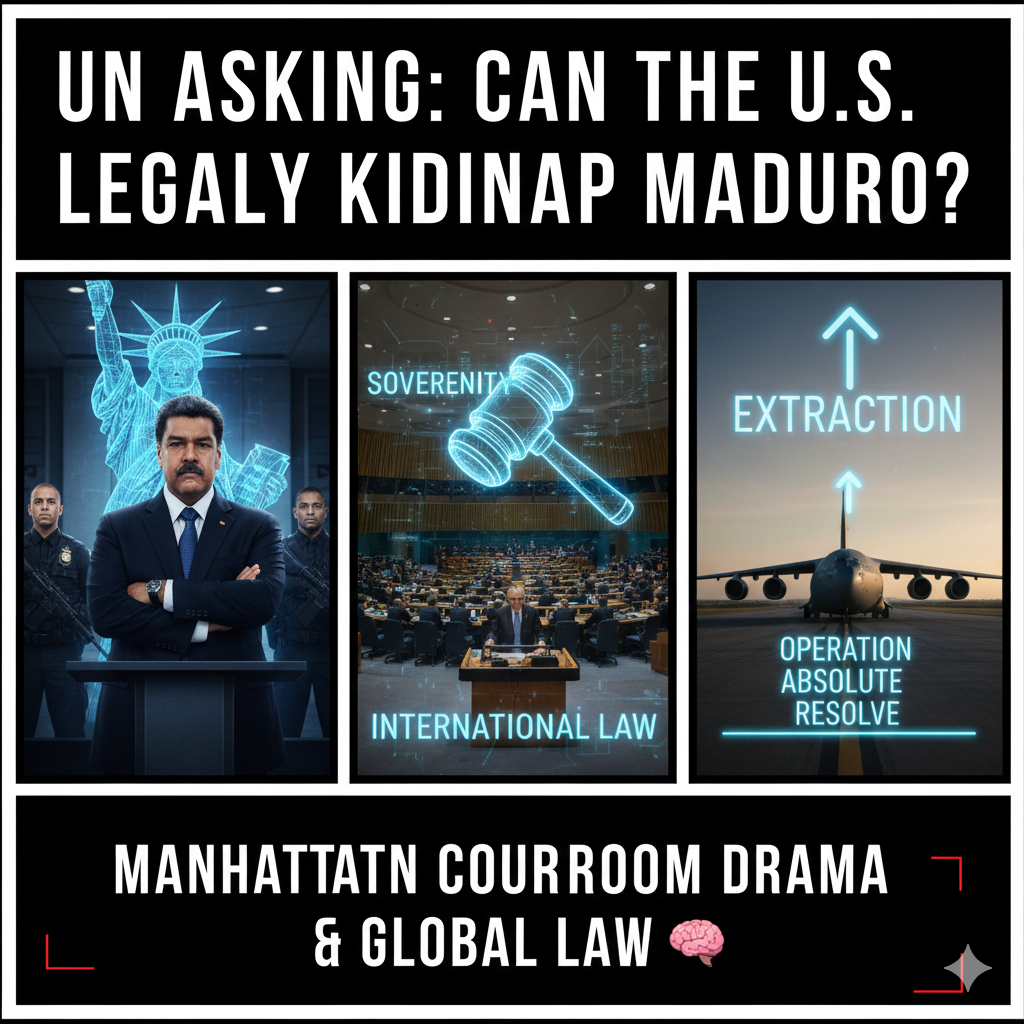

Now, the United Nations and various international law experts condemned the U.S. capture of Nicolás Maduro, asserting it had no basis in international law. While U.S. domestic law allows for such prosecutions, the act is widely viewed as a violation of sovereign principles.
International Law (The UN View)
UN Secretary-General António Guterres described the operation as a “dangerous precedent”. Legal experts and UN officials have highlighted violations of international law, including the prohibition on the use of force against the territorial integrity or political independence of any state under Article 2(4) of the UN Charter. They also argue that heads of state typically have immunity from foreign criminal jurisdiction and that the operation lacked authorization from the UN Security Council.
U.S. Domestic Law (The “Kidnapping” Loophole)
Despite international condemnation, U.S. courts are expected to proceed with Maduro’s trial based on several domestic legal principles. The Ker-Frisbie Doctrine allows U.S. courts to maintain jurisdiction over a defendant even if they were brought to the U.S. illegally or by force. The U.S. bypasses claims of head-of-state immunity by not recognizing Maduro as a legitimate president and references the capture and trial of Panama’s Manuel Noriega in 1989 as a precedent.
Current Status (January 2026)
Following his capture, Maduro and his wife, Cilia Flores, were transported to New York and are being held at the Metropolitan Detention Center in Brooklyn. They are scheduled to appear in federal court on January 5, 2026, to face drug-trafficking and narco-terrorism charges.